Quick Answer
Vector databases and retrieval-augmented generation, usually called RAG, help AI systems answer from selected documents, knowledge bases, tickets, policies, product notes, and business records instead of relying only on model memory. In 2026, the best RAG systems are not only about storing embeddings. They are about building a reliable retrieval workflow that can find the right source, respect permissions, cite evidence, avoid stale content, and tell users when the available context is not enough.
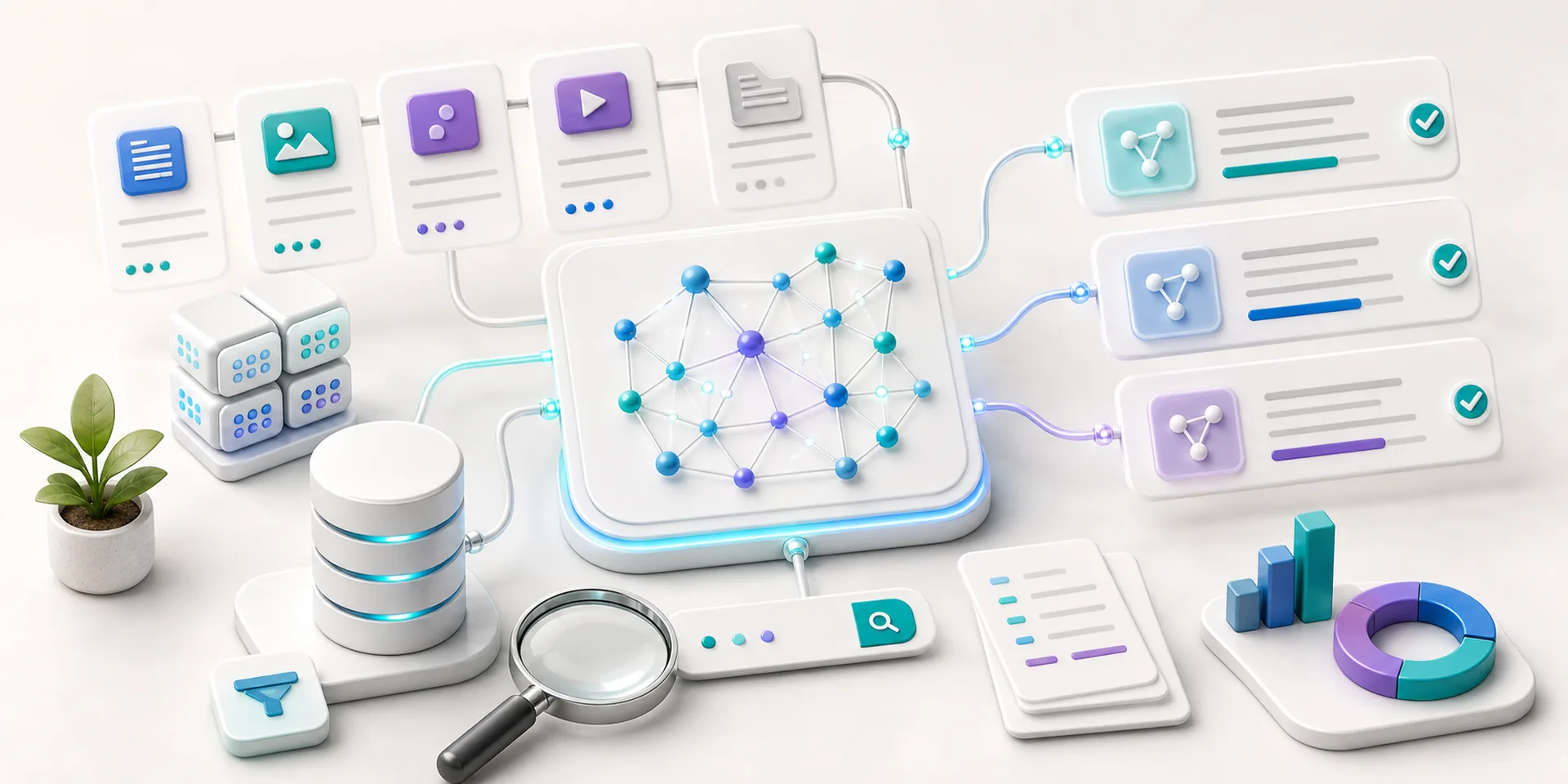
A strong RAG implementation has several layers: source selection, ingestion, chunking, metadata, embeddings, retrieval, re-ranking, prompt construction, answer generation, citation checking, evaluation, and feedback. The vector database is important, but it is only one part of the architecture. A weak content library, poor chunking strategy, missing permissions, or untested retrieval logic can make even a strong model produce unreliable answers.
Why Vector Databases Matter In RAG
Language models are good at generating fluent answers, but they do not automatically know a company’s latest policies, customer-specific procedures, internal architecture standards, support articles, or contract language. RAG adds a retrieval step before generation. The system searches for relevant content, sends selected context to the model, and asks the model to answer based on that evidence.
Vector databases support this workflow by storing embeddings, which are numerical representations of text, documents, or other content. When a user asks a question, the system can compare the question embedding against stored embeddings and retrieve similar chunks. This helps with semantic search where exact keywords may not match. For example, a user may ask, “How do we rotate service credentials?” while the internal document says “secret rotation procedure.” Vector search can connect those ideas better than simple keyword search.
The practical challenge is that similarity is not the same as correctness. A vector database may retrieve a related paragraph that is not the best answer. It may retrieve an outdated policy. It may retrieve content the user should not see. It may retrieve a chunk that looks relevant but lacks the surrounding context needed to answer safely. That is why RAG architecture needs governance, evaluation, and human review for high-risk workflows.
Decision Framework
Use this framework before choosing a vector database or launching a RAG assistant.
| Architecture area | What to decide | Why it matters |
|---|---|---|
| Source scope | Which documents, databases, tickets, pages, or files can be indexed | Prevents low-quality or unauthorized sources from shaping answers |
| Chunking strategy | How content is split, labeled, and grouped | Affects retrieval accuracy and citation quality |
| Metadata | Source, owner, date, version, sensitivity, department, product, and access level | Helps filtering, freshness checks, and governance |
| Embedding model | Which model converts content into vectors | Influences semantic matching and cost |
| Retrieval method | Vector search, keyword search, hybrid search, filters, or re-ranking | Improves relevance for different query types |
| Permission handling | Whether retrieval respects user access rights | Protects confidential data |
| Citation rules | Whether answers must link to exact supporting sources | Helps users verify claims |
| Evaluation process | Test questions, expected sources, answer grading, and user feedback | Shows whether RAG is actually reliable |
| Update process | How stale, duplicate, or deleted content is removed | Reduces outdated answers |
Example Scenario
Imagine an enterprise cloud team building an internal AI assistant for platform engineers. The assistant should answer questions about landing zones, network patterns, identity rules, incident playbooks, Terraform modules, approved services, and deployment standards.
The first version may seem simple: index the documentation site, create embeddings, connect a chatbot, and let users ask questions. But real enterprise content is messy. Some pages are old. Some diagrams are stored in PDFs. Some standards apply only to one region. Some incident notes should not be visible to everyone. A runbook may refer to a deprecated tool. A newer architecture decision record may override an older wiki page.
A useful RAG design would not index everything blindly. The team would start with approved platform documentation, add metadata for owner and version, exclude archived pages, and apply access rules so security-only content is not retrieved for general users. It would test common questions such as “which subnet pattern should I use for production?” and edge cases such as “can I deploy this service in a regulated workload?” The answer should cite the approved standard, not a random Slack export or an outdated design draft.
This is where vector databases become part of a larger operating model. The retrieval layer must be connected to content ownership, update cadence, permission filters, and answer evaluation. Otherwise the assistant may sound confident while giving answers that are stale, incomplete, or not allowed for the user.
RAG Implementation Pattern
Start with a narrow workflow. Choose one use case such as support search, policy Q&A, engineering runbooks, sales enablement, or research notes.
Select authoritative sources. Index only documents that have clear owners and practical value.
Clean and prepare content. Remove duplicates, old pages, boilerplate, navigation text, and irrelevant attachments.
Design chunking rules. Split content so each chunk is meaningful, but not so large that it wastes context or so small that it loses meaning.
Add metadata. Track source, owner, date, sensitivity, topic, product, region, and version.
Choose retrieval logic. Combine vector search with keyword search, filters, or re-ranking when exact terms and semantic meaning both matter.
Build answer rules. Require citations, uncertainty language, and refusal behavior when sources are weak.
Evaluate with real questions. Test expected sources, answer quality, citation accuracy, permission handling, and stale-source behavior.
Create a feedback loop. Let users report bad answers, missing sources, and wrong citations.
Review regularly. RAG quality changes as documents, products, policies, and user questions change.
Risk Checklist
Before launching a RAG system, review these risks:
- Are indexed sources approved and current?
- Can the system retrieve restricted documents for the wrong user?
- Are old and new versions of the same policy both indexed?
- Does the answer cite sources that actually support the claim?
- Are document owners responsible for source quality?
- Can users report wrong or missing answers?
- Are embeddings and vector indexes treated as derived data?
- Is retention defined for documents, chunks, logs, and feedback?
- Are high-risk answers reviewed by humans before action?
- Is there a rollback plan if the assistant gives harmful guidance?
Metrics To Track
| Metric | What it shows | Practical use |
|---|---|---|
| Retrieval relevance | Whether the right chunks are returned | Improves search configuration |
| Citation accuracy | Whether citations support the exact answer | Reduces misleading references |
| Source freshness | Whether answers use current documents | Prevents stale guidance |
| Coverage gaps | Questions with no good source | Identifies missing knowledge |
| No-answer rate | Cases where the assistant admits insufficient evidence | Encourages safer behavior |
| Permission failures | Restricted sources retrieved incorrectly | Protects sensitive information |
| User correction rate | How often users reject or edit answers | Measures practical usefulness |
| Cost per answer | Embeddings, retrieval, model calls, and review effort | Keeps the system sustainable |
| Latency | Time from query to usable answer | Affects adoption |
Common Mistakes
The biggest mistake is treating RAG as a database project only. A vector database can store embeddings, but it cannot decide which documents are trustworthy, which sources are outdated, or which answers need human review.
Other mistakes include:
- indexing every document without quality checks
- using chunking defaults without testing retrieval results
- ignoring metadata and permissions
- relying only on vector similarity when exact terms matter
- treating citations as proof without checking whether they support the answer
- failing to remove archived or superseded content
- measuring user satisfaction but not source accuracy
- assuming RAG removes the need for content ownership
Official Resources
- Microsoft Azure AI Search RAG overview
- OpenAI File Search documentation
- Google Vertex AI Search documentation
- Pinecone guide to retrieval-augmented generation
- NIST AI Risk Management Framework
Related AI Charcha Reading
- Enterprise RAG Governance Framework for 2026
- AI Search Reliability in 2026
- Context Engineering Evaluation Framework
- Data Retention Choices for AI Tools
- AI Evaluation Metrics for Enterprise Teams
- How to Build an AI Research Workflow
Frequently Asked Questions
Is a vector database required for RAG?
Not always. Some RAG systems can use keyword search, hybrid search, databases, or structured APIs. A vector database is useful when semantic matching across unstructured content is important.
What is the difference between vector search and keyword search?
Keyword search matches exact words or terms. Vector search matches meaning based on embeddings. Many strong RAG systems use hybrid search because business content often needs both semantic matching and exact terminology.
Why do RAG systems still hallucinate?
RAG reduces hallucination risk, but it does not remove it. The system may retrieve weak sources, miss the right document, use stale content, cite the wrong passage, or let the model answer beyond the evidence.
How should teams evaluate RAG quality?
Use realistic questions with expected sources. Check retrieval relevance, citation accuracy, source freshness, permission handling, answer completeness, no-answer behavior, and user correction patterns.
What should not go into a RAG index?
Do not index sensitive, regulated, outdated, duplicate, unapproved, or poorly owned content without clear access controls and retention rules. A bad source library makes the whole assistant harder to trust.
Bottom Line
Vector databases are useful for RAG, but they are not the whole answer. The real work is building a trustworthy retrieval system around them.
Start with a narrow workflow, index authoritative sources, preserve permissions, design chunking and metadata carefully, test retrieval with real questions, require citations where needed, and keep improving the source library. A RAG system becomes valuable when users can trust both the answer and the evidence behind it.